
By Dr Asim Shrestha | Child Neurologist | Nepal
Seizures in children can be frightening for parents. Many people associate seizures with falling to the ground and shaking of the whole body. However, seizures can present in many different ways. Some children may suddenly stare into space, experience unusual jerking movements, become stiff, or have brief episodes of unresponsiveness.
Understanding the different types of seizures in children helps parents recognize warning signs and seek timely medical attention.
In this article, we explain the common types of childhood seizures, their symptoms, causes, diagnosis, and treatment options.
What Is a Seizure in a Child?
A seizure is a sudden episode of abnormal electrical activity in the brain that temporarily affects a child’s movement, behavior, awareness, or sensations.
Depending on which part of the brain is involved, a seizure may cause:
- Sudden jerking of the arms or legs
- Stiffening of the body
- Brief staring episodes
- Sudden loss of awareness
- Repeated blinking or lip-smacking
- Sudden falls
- Unusual sensations or behavior
Not every seizure involves shaking or loss of consciousness.
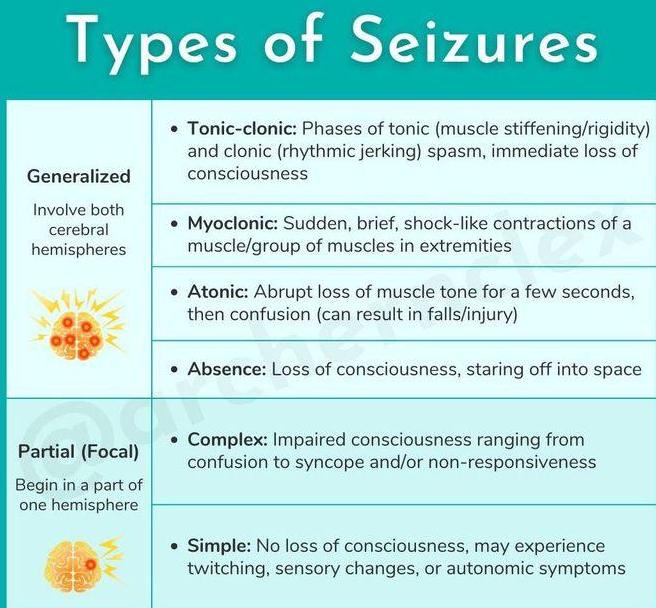
What Are the Main Types of Seizures in Children?
According to the International League Against Epilepsy (ILAE), seizures are broadly classified into three main categories:
- Focal-onset seizures
- Generalized-onset seizures
- Unknown-onset seizures
1. Focal Seizures
Focal seizures begin in one specific area of the brain.
The symptoms depend on which brain region is affected.
Common symptoms include:
- Jerking of one arm, leg, or one side of the face
- Sudden staring or reduced awareness
- Repeated lip-smacking or chewing movements
- Unusual sensations or fear
- Sudden behavioral changes
- Turning of the head or eyes to one side
Focal seizures may occur with preserved awareness or impaired awareness.
Example: A child may suddenly stop playing, stare blankly, repeatedly move their lips, and remain unresponsive for a short period.
2. Generalized Seizures
Generalized seizures involve networks on both sides of the brain from the beginning.
There are several types.
A. Tonic-Clonic Seizures
These are commonly recognized as convulsive seizures.
Symptoms:
- Sudden loss of consciousness
- Stiffening of the entire body (tonic phase)
- Repeated jerking movements of the arms and legs (clonic phase)
- Possible tongue biting
- Sometimes loss of bladder control
- Sleepiness or confusion after the seizure
Most seizures stop spontaneously within a few minutes.
B. Tonic Seizures
Tonic seizures cause sudden stiffening of the body or limbs.
Symptoms:
- Sudden body stiffness
- Arms and legs become rigid
- Head may move backward
- Sudden falls may occur
These seizures are commonly associated with certain childhood epilepsy syndromes, including Lennox-Gastaut syndrome.
C. Clonic Seizures
Clonic seizures involve repeated rhythmic jerking movements.
Symptoms:
- Repeated jerking of arms or legs
- Rhythmic muscle contractions
- Movements may involve one or both sides of the body
D. Myoclonic Seizures
Myoclonic seizures cause sudden, brief, shock-like muscle jerks.
Symptoms:
- Sudden jerking of the shoulders or arms
- Sudden dropping of objects
- Brief jerks, especially after waking up
- Jerks may occur in clusters
They are seen in conditions such as juvenile myoclonic epilepsy.
E. Absence Seizures
Absence seizures are common in school-aged children.
Parents and teachers may mistake them for daydreaming.
Symptoms:
- Sudden staring into space
- Sudden interruption of speaking or activity
- Brief unresponsiveness
- Rapid blinking or subtle mouth movements
- Sudden return to normal activity
These episodes usually last a few seconds and may occur many times a day.
F. Atonic Seizures
Atonic seizures cause sudden loss of muscle tone.
Symptoms:
- Sudden head dropping
- Sudden loss of body posture
- Unexpected falls
- Brief loss of muscle control
These are sometimes called drop attacks and may result in head injuries.
G. Epileptic Spasms (Infantile Spasms)
Epileptic spasms are an important seizure type occurring mainly in infancy.
They usually begin during the first year of life.
Symptoms:
- Sudden bending forward of the head and body
- Sudden extension of the arms and legs
- Brief repeated flexion or extension movements
- Episodes occurring in clusters
- Often occurring after waking up
Parents may describe them as repeated head nodding or sudden abdominal crunching movements.
Important: Suspected infantile spasms require urgent assessment by a pediatric neurologist because early diagnosis and treatment can improve developmental outcomes.
3. Unknown-Onset Seizures
Sometimes the beginning of a seizure is not witnessed. In these situations, the seizure may initially be classified as unknown onset.
Further clinical evaluation, video recordings, and EEG findings may help establish the seizure type.
How to Recognize Seizures in Babies and Young Children?
Seizures in infants may look different from seizures in older children.
Parents should watch for:
- Repeated sudden head nodding
- Unusual eye movements or eye deviation
- Repeated stiffening of the arms or legs
- Sudden episodes of unresponsiveness
- Repeated rhythmic jerking
- Clusters of unusual movements, especially after waking up
- Sudden episodes of loss of muscle tone
Not all unusual movements are seizures. Some normal infant movements, sleep-related movements, and movement disorders can resemble seizures.
A video recording of the episode can be very helpful for diagnosis.
What Causes Seizures in Children?
Several conditions can cause seizures during childhood.
Common causes include:
- Fever-related seizures (febrile seizures)
- Genetic epilepsy
- Brain infections such as meningitis and encephalitis
- Birth-related brain injury or hypoxic-ischemic encephalopathy
- Brain malformations
- Head injury
- Low blood glucose or electrolyte abnormalities
- Metabolic and mitochondrial disorders
- Brain tumors or other structural brain abnormalities
The underlying cause varies with the child’s age, medical history, and seizure presentation.
How Are Seizures Diagnosed in Children?
A detailed clinical assessment is the most important first step.
A child neurologist may recommend the following investigations:
1. EEG (Electroencephalogram)
EEG records the electrical activity of the brain and helps identify abnormal electrical discharges associated with epilepsy.
2. Video EEG Monitoring
Video EEG records the child’s behavior and brain electrical activity simultaneously. It is particularly useful when the diagnosis is uncertain.
3. MRI Brain
MRI helps identify structural abnormalities, brain malformations, previous brain injuries, and other neurological conditions.
4. Blood Investigations
Blood tests may be required to assess glucose, electrolytes, calcium, and other metabolic abnormalities.
5. Genetic Testing
Genetic testing may be considered in children with early-onset epilepsy, developmental delay, drug-resistant seizures, or suspected genetic epilepsy syndromes.
What Is the Treatment for Seizures in Children?
Treatment depends on the seizure type, underlying cause, age of the child, and epilepsy syndrome.
Available treatment options include:
- Anti-seizure medications (ASMs)
- Ketogenic diet for selected children with drug-resistant epilepsy
- Epilepsy surgery in appropriately selected patients
- Vagus nerve stimulation (VNS)
- Treatment of underlying metabolic or genetic conditions
- Rehabilitation and developmental support when required
Choosing the correct medication is important because some anti-seizure medicines may worsen particular seizure types.
Treatment should always be individualized by a qualified medical professional.
What Should Parents Do During a Seizure?
Knowing seizure first aid can prevent injuries and save lives.
DO:
- Stay calm and note the time.
- Place the child on a safe, flat surface.
- Turn the child gently onto their side when possible.
- Remove nearby dangerous objects.
- Protect the child’s head.
- Stay with the child until recovery.
DO NOT:
- Do not put a spoon, finger, or any object inside the mouth.
- Do not forcefully hold the child’s arms or legs.
- Do not give food, water, or oral medicine during the seizure.
- Do not try to stop the jerking movements.
When should parents seek emergency medical care?
Seek emergency help if:
- The seizure lasts 5 minutes or longer.
- Another seizure starts before the child recovers.
- The child has difficulty breathing or does not regain consciousness.
- The seizure occurs in water.
- The child is seriously injured.
- It is the child’s first seizure.
Follow an individualized emergency seizure plan if your child’s neurologist has provided one.
When Should You Consult a Child Neurologist?
You should consult a child neurologist if your child has:
- Repeated episodes of staring or unresponsiveness
- Unexplained jerking movements
- Recurrent episodes of sudden falls
- Unusual movements during sleep or after waking
- Suspected infantile spasms
- Seizures associated with developmental delay
- Recurrent seizures despite medication
Early diagnosis and appropriate treatment can help improve seizure control and support a child’s development and quality of life.
Frequently Asked Questions (FAQs)
1. What are the most common types of seizures in children?
Common seizure types include focal seizures, tonic-clonic seizures, absence seizures, myoclonic seizures, tonic seizures, clonic seizures, atonic seizures, and epileptic spasms.
2. Can a child have seizures without shaking?
Yes. Absence seizures and some focal seizures may present as staring, unresponsiveness, unusual behavior, or subtle repetitive movements without generalized shaking.
3. What is the difference between a seizure and epilepsy?
A seizure is an individual episode of abnormal electrical activity in the brain. Epilepsy is a neurological disorder characterized by an enduring tendency to have recurrent unprovoked seizures, meeting accepted diagnostic criteria.
4. Are all seizures in children dangerous?
Not all seizures cause long-term harm. However, prolonged seizures, repeated seizures without recovery, and seizures caused by serious underlying conditions require urgent medical attention.
5. Can childhood epilepsy be cured?
Many children achieve long-term seizure freedom, and some childhood epilepsy syndromes resolve with age. Outcomes depend on the epilepsy syndrome, underlying cause, and response to treatment.
6. Can fever cause seizures in children?
Yes. Febrile seizures can occur in young children, usually between 6 months and 5 years of age, in association with fever. They are different from epilepsy.
Conclusion
Seizures in children can present in many different ways, from brief staring episodes to generalized convulsions and sudden falls. Recognizing the different seizure types is essential for early diagnosis and appropriate treatment.
If your child experiences unusual movements, repeated staring episodes, or unexplained episodes of unresponsiveness, seek evaluation by a child neurologist.
Dr Asim Shrestha – Child Neurologist, Nepal
For consultation and evaluation of childhood seizures, epilepsy, and other neurological conditions, visit:
Website: https://drasimchildneuro.com