
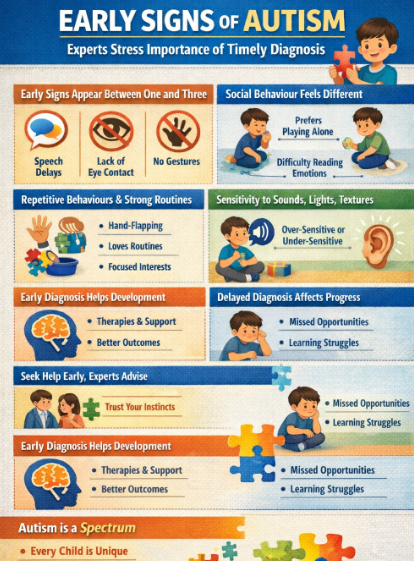
Early signs of autism in children may appear during the first few years of life. Parents may notice that their child does not respond consistently to their name, has delayed speech, makes limited eye contact, or shows less interest in interacting with others. Recognizing these signs early and seeking professional evaluation can help children access appropriate support during their development.
Autism spectrum disorder (ASD) is a neurodevelopmental condition that affects social communication, interaction, behavior, and patterns of interests. Every autistic child is different. Some children show signs in infancy, while others become more noticeable as social and communication demands increase.
If you are concerned about your child’s development, you do not need to wait until your child starts school to seek advice.
What Are the Early Signs of Autism in Children?
Early signs of autism can involve communication, social interaction, play, behavior, and sensory responses. One sign alone does not necessarily mean a child has autism, but a combination of signs warrants further assessment.
1. Limited Response to Name
A child may not consistently turn around or look toward a parent when their name is called, even when there are no obvious hearing difficulties.
2. Limited Eye Contact and Social Interaction
Some children may make less eye contact, show limited social smiling, or appear less interested in sharing experiences with parents and other children. However, eye contact varies between children and should not be used alone to diagnose autism.
3. Delayed Speech and Communication
A child may start speaking later than expected, use fewer gestures, or have difficulty communicating needs. Some children speak fluently but struggle with the social use of language, such as maintaining a conversation or sharing interests.
4. Limited Gestures and Joint Attention
Watch whether your child points to show you something interesting, waves goodbye, reaches to be picked up, or looks between an object and your face to share an experience.
Difficulty with pointing to share interest or following another person’s point may be an early sign of differences in social communication.
5. Repetitive Movements or Behaviors
Some children may flap their hands, rock their bodies, spin objects, repeat words or phrases, or perform the same actions repeatedly. These behaviors can occur for different reasons, so their context and frequency matter.
6. Strong Preference for Routines
A child may become unusually distressed by small changes in daily routines, the arrangement of toys, or the usual route to a familiar place.
7. Unusual Sensory Responses
Some children may be unusually sensitive to loud sounds, bright lights, clothing textures, or certain foods. Others may seek sensory experiences, such as spinning objects, watching moving patterns, or repeatedly touching particular textures.
8. Differences in Pretend Play and Social Play
A child may show limited pretend play, such as feeding a doll or pretending a toy car is driving to a destination. Some children may prefer playing alone or find it difficult to engage in back-and-forth play with other children.
Remember that autistic children can enjoy affection, form close relationships, and develop strong interests. Autism does not look the same in every child.
Early Signs of Autism by Age
The following are developmental warning signs, not diagnostic criteria. Children develop at different rates, and concerns should be assessed in the context of the child’s overall development.
| Age | Signs that may warrant evaluation |
|---|---|
| By 6 months | Limited social smiling or reduced back-and-forth facial expressions |
| By 9 months | Limited sharing of facial expressions, sounds, or other social responses |
| By 12 months | Limited gestures, such as waving; inconsistent response to name |
| By 16 months | No spoken words may warrant developmental assessment |
| By 18 months | Limited pointing to share interest, reduced joint attention, or limited social communication |
| By 24 months | No spontaneous two-word phrases, limited pretend play, or persistent social communication concerns |
Important: These ages are useful checkpoints, not deadlines for diagnosing autism. A child may have autism even if some milestones are present. Any loss of previously acquired language, social, or other developmental skills needs prompt medical assessment.
When Should You See a Doctor for Possible Autism?
Parents should consult a pediatrician or child neurologist if they notice one or more persistent developmental concerns, especially when several signs occur together.
Seek a developmental evaluation if your child:
- Does not consistently respond to their name.
- Rarely points to share interest or show you something.
- Has delayed speech or difficulty communicating needs.
- Shows limited back-and-forth social interaction.
- Repeats movements or behaviors alongside social communication differences.
- Has difficulty with changes in routines or shows unusually restricted interests.
- Has lost words, social engagement, or other previously acquired skills.
Do not wait for all the signs to appear. Early evaluation can clarify your child’s needs and help determine whether developmental support is appropriate.
If your child suddenly loses skills, develops new weakness, or experiences seizures or altered awareness, seek prompt medical assessment. Sudden neurological changes may require urgent care.
Can Autism Be Diagnosed Before 2 Years of Age?
Yes. Autism can sometimes be reliably identified by experienced professionals around 18–24 months, although some children are identified earlier and others later.
Diagnosis involves assessing the child’s developmental history, social communication, behavior, and restricted or repetitive patterns. There is no single blood test, brain scan, or genetic test that can independently diagnose autism.
A clinician may recommend:
- A detailed developmental history and clinical assessment.
- Standardized autism-specific assessment tools when appropriate. M-CHAT scoring for toddlers, Indian Scale for Assessment of Autism (ISAA) to assess the grades of autism
- Hearing and speech-language evaluation.
- Additional investigations when indicated by the child’s history or examination.
Autism screening tools can help identify children who need further assessment, but a screening result alone does not confirm or exclude a diagnosis.
What Should Parents Do If They Suspect Autism?
Step 1: Record Your Observations
Write down the behaviors that concern you, when they occur, and how your child communicates at home and outside. Short videos of relevant behaviors may help the clinician understand your concerns.
Step 2: Arrange a Developmental Assessment
Consult a pediatrician, developmental pediatrician, or child neurologist experienced in child development and autism. The clinician can assess whether the observed signs are consistent with autism or another developmental condition.
Step 3: Check Hearing, Speech, and Overall Development
Speech delay can have several causes, including hearing difficulties and broader developmental differences. Appropriate evaluation helps identify your child’s needs.
Step 4: Start Appropriate Support Without Unnecessary Delay
Depending on the child’s needs, support may include speech and language therapy, parent-mediated communication strategies, occupational therapy for specific functional or sensory needs, and developmental or behavioral interventions.
You do not always need to wait for a definitive autism diagnosis to begin addressing a child’s communication and developmental difficulties.
Step 5: Monitor Progress and Support the Family
Regular follow-up helps track communication, learning, behavior, sleep, feeding, and participation in everyday activities. Parents and teachers can work together to support the child’s development.
Is Autism Curable?
Autism is a neurodevelopmental condition, not an illness that can simply be cured with a medicine. However, appropriate developmental support can help children build communication, learning, daily living, and social participation skills.
Treatment should be individualized. Medicines may be considered for specific co-occurring problems, such as severe irritability, sleep difficulties, or ADHD symptoms, when clinically appropriate. No medicine currently treats the core features of autism itself.
The goal is to understand the child’s strengths and needs, improve quality of life, and support development rather than trying to make every autistic child behave in the same way.
Frequently Asked Questions About Early Signs of Autism
1. What is the first sign of autism in a child?
Early signs may include reduced social smiling, limited response to name, limited gestures, reduced joint attention, or differences in social communication. There is no single first sign that applies to every child.
2. Does delayed speech always mean autism?
No. Speech delay can occur for many reasons. Hearing difficulties, language disorders, and broader developmental delays should also be considered. A developmental assessment helps clarify the cause.
3. Can a child have autism and still make eye contact?
Yes. Some autistic children make eye contact, speak fluently, show affection, and have strong social interests. Autism is diagnosed from a broader pattern of developmental features, not one behavior.
4. Should I wait until my child is 3 years old for an autism assessment?
No. If you have concerns, seek an evaluation as early as possible. Early assessment can help identify support needs, even when a definitive diagnosis is not yet possible.
5. Who diagnoses autism in children in Nepal?
Depending on local services and the child’s needs, assessment may involve a pediatrician, developmental pediatrician, child neurologist, child psychiatrist, psychologist, speech-language therapist, or a multidisciplinary team. A qualified clinician with appropriate autism assessment experience should coordinate or contribute to the diagnostic process.
6. Does early intervention help children with autism?
Early, individualized support can improve functional communication, learning, adaptive skills, and participation in daily activities. Progress varies between children, and support should be tailored to their individual needs.
When to Consult a Child Neurologist in Nepal
If you are concerned about delayed speech, reduced social interaction, repetitive behaviors, loss of developmental skills, or other neurological and developmental symptoms, a professional assessment can help you understand the next steps.
At drasimchildneuro.com, parents can learn more about child neurology, developmental delay, autism, and when to seek professional guidance.
Book a developmental consultation with Dr. Asim Shrestha, Child Neurologist, in Nepal, if you have concerns about your child’s development. Early recognition, appropriate assessment, and individualized support can make a meaningful difference in a child’s developmental journey.